It’s been a busy quarter for all things energy in Westminster beyond. A new Prime Minister has taken office, and energy costs have been high on the agenda from the outset, with the introduction of a temporary Electricity VAT cut for 5% suppliers, and the recent announcement of Great British Grid.
Amid the headlines and high-level policy, it’s easy to lose sight of ongoing regulatory workstreams and their impact on business. In this edition, we bring you the latest on several key items still on the radar, including the opening of applications for the British Industrial Competitiveness Scheme (BICS), the policy decision on smart-contingent contracts and ongoing TPI engagement and regulation readiness.
British Industrial Competitiveness Scheme (BICS) opens to applicants
The British Industrial Competitiveness Scheme (BICS) was announced as part of the Industrial Strategy to cut electricity costs for British manufacturers, strengthening competitiveness and protecting skilled jobs.
Eligible businesses will be exempt from the indirect costs of the Renewables Obligation and Feed-in Tariffs schemes from April 2027 consumption onwards, and from the costs of the Capacity Market from October 2027 consumption onwards. Together, these exemptions are worth around £40 per MWh.
Businesses that qualify in the first application window will also receive an additional payment in 2027, reflecting the support they would have received had the scheme been in operation earlier.
To qualify, a business must:
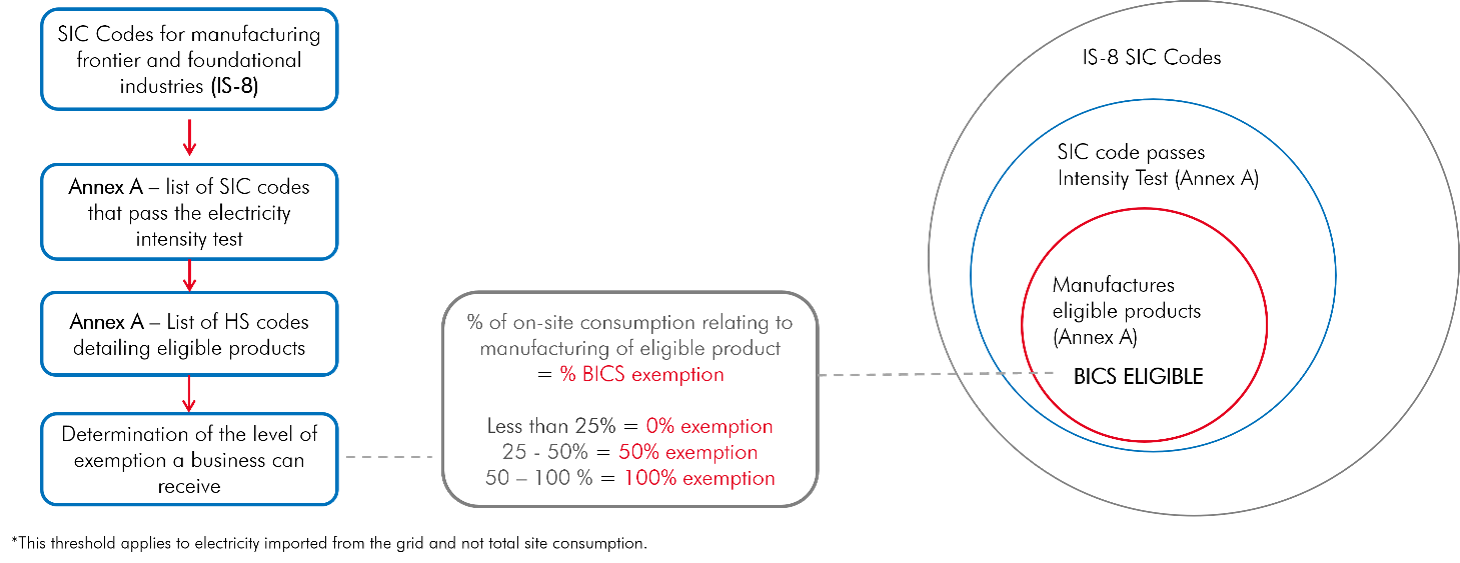
Government has also made a handy eligibility checker – which businesses can access to see whether they are likely to qualify based on their Companies House number, address, manufactured product and annual electricity consumption.
BICS Eligibility Checker >Businesses that appear eligible should consult the business guidance to understand the evidence requirements, then apply here. Applications close on 30 November 2026.
Eligible applicants will be confirmed in January 2027, and suppliers will be notified of their relevant customers via a centrally managed register.
Apply for BICS >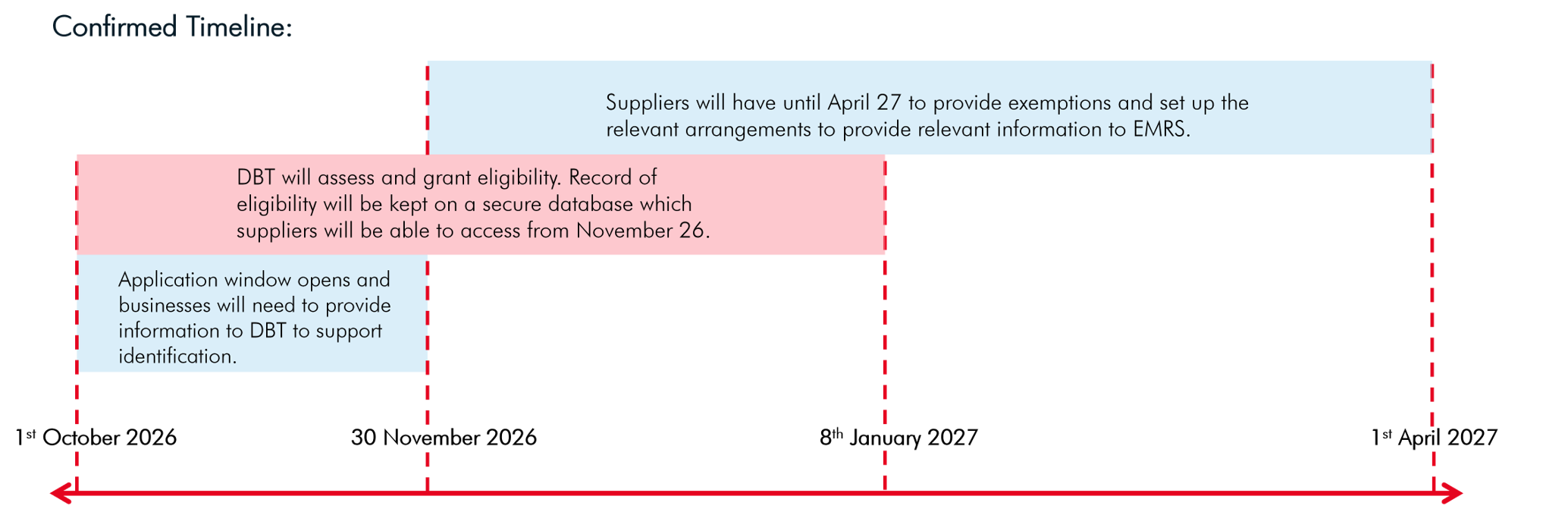
5% Electricity VAT Cut to 0%
From 1 October 2026 to 31 March 2027, the 5% reduced rate of VAT on qualifying electricity supplies will fall to 0%, saving the average household around £45.
The change will not affect most businesses, which will continue to be charged the standard 20% rate on all electricity supplies. However, qualifying businesses currently charged 5% will see their rate reduced automatically. These include:
- charities and not-for-profit organisations
- mixed-use premises where more than 60% of energy is used for domestic purposes
- low-consuming business sites that do not exceed an average rate of 33kWh per day or 1,000kWh per month (de minimis threshold).
CGP customers currently charged the reduced rate of 5% do not need to take any action, as the new 0% rate will be applied automatically to relevant invoices and consumption.
Businesses currently charged the standard 20% rate that believe they are eligible for the reduced rate (5%, moving to 0%) should complete our online VAT declaration form.
VAT Form >Businesses currently receiving the reduced rate that believe they no longer meet the eligibility criteria should also notify us of the change using the relevant form.
Please note that eligibility is assessed solely on the information submitted. Any business unsure whether it qualifies, or continues to qualify, is advised to contact HMRC for further information and guidance.
Smart-Contingent Contracts from September 2027.
On 1 September, government confirmed its decision to proceed with the non-domestic smart-contingent contracts policy package, first consulted on in October 2025.
This means that from 1 September 2027, any new fixed-term contract a supplier enters into with a non-domestic customer must include a term providing that the customer has, or agrees to have, a smart meter (or advanced meter) installed at any designated premises.
Government has not prescribed how individual suppliers should enforce smart-contingent terms. However, a new Retail Energy Code (REC) Consumer Protection Schedule, in effect from 1 September 2027, requires them to do so fairly, providing the customers with an opportunity to clarify their individual circumstances, ensuring they do not penalise customers for delays outside their control, such as landlord refusal or equipment or installation failures. Suppliers must also consider financial difficulty, residents at the premises and any Critical National Infrastructure before enforcing any relevant term.
Suppliers are also expected to support customers in meeting smart-contingent terms by taking all reasonable steps to progress installations in line with the schedule. This includes booking an installation appointment within the first three months of the contract, and ensuring the appointment takes place successfully within 12 months of [TO CONFIRM – e.g. the contract start date].
From January 2027, suppliers must begin clearly communicating upcoming policy and contractual changes, so that affected customers understand what is happening, when and why. At CGP, we have already included a smart-contingent provision in the latest review of our General Terms & Conditions, which will come into effect once the requirement for suppliers to offer such contracts becomes legally binding.
Ongoing Scheme Design for Bill Discounts for New Transmission Network Infrastructure
On 27 July, DESNZ published a policy paper providing further detail on the Bill Discount Scheme for Transmission Network Infrastructure. It expands on the scheme design set out in the initial government response, which we covered in our Q2 update.
Bill Discount Scheme Policy >As a reminder, the scheme will give single-household properties within 500 metres of new or significantly upgraded onshore transmission infrastructure up to £250 a year off their electricity bills for 10 years, with first payments expected in the first half of 2027. Most households will receive the discount automatically through their supplier, in two six-monthly instalments of £125.
However, households with non-standard electricity arrangements, including those supplied under a non-domestic contract, will need to apply through an Ofgem-administered opt-in route, which is still being developed. These households will receive their discount directly from Ofgem, by bank transfer or cash voucher. Multiple occupancy buildings such as apartment blocks, care homes and student accommodations are excluded due to perceived administrative complexity.
Although the discount is available only to households, estimating to support up to 160,000 properties at its peak, the scheme will be funded by both domestic and non-domestic electricity suppliers.
TPI Regulation Update: An Outcomes Based Framework
Ofgem continues to prepare for its future role as regulator of third-party intermediaries (TPIs). It is currently gathering insight from TPIs, suppliers, consumer groups and customers, including through its TPI forums, to understand how the sector works and the role TPIs play.
At the beginning of this quarter, Ofgem’s consumer protection and competition team, which is leading the TPI workstream, published a blog alongside good practice guidance on setting up energy contracts.
Good practice guidance >The guidance takes a clear outcomes-based approach, built around three outcomes for customers:
- Receiving clear, accurate and timely information
- Having complaints handled fairly, effectively and promptly
- Paying prices that reflect fair value for the service provided
In practice, this means TPIs being transparent about their role and how much of the market they search, setting out a contract’s principal terms before the customer agrees, and clearly explaining commission and fees.
The guidance is not enforceable, but it gives a clear indication of the direction of future regulation, and Ofgem expects TPIs that align with it now to be well placed when formal rules arrive. Ofgem aims to complete its review of the sector this year and to set out initial proposals for consultation next year. TPIs that are not yet part of Ofgem’s forums are encouraged to get in touch at TPI@ofgem.gov.uk.
Consumer Outcomes – Proposed Implementation
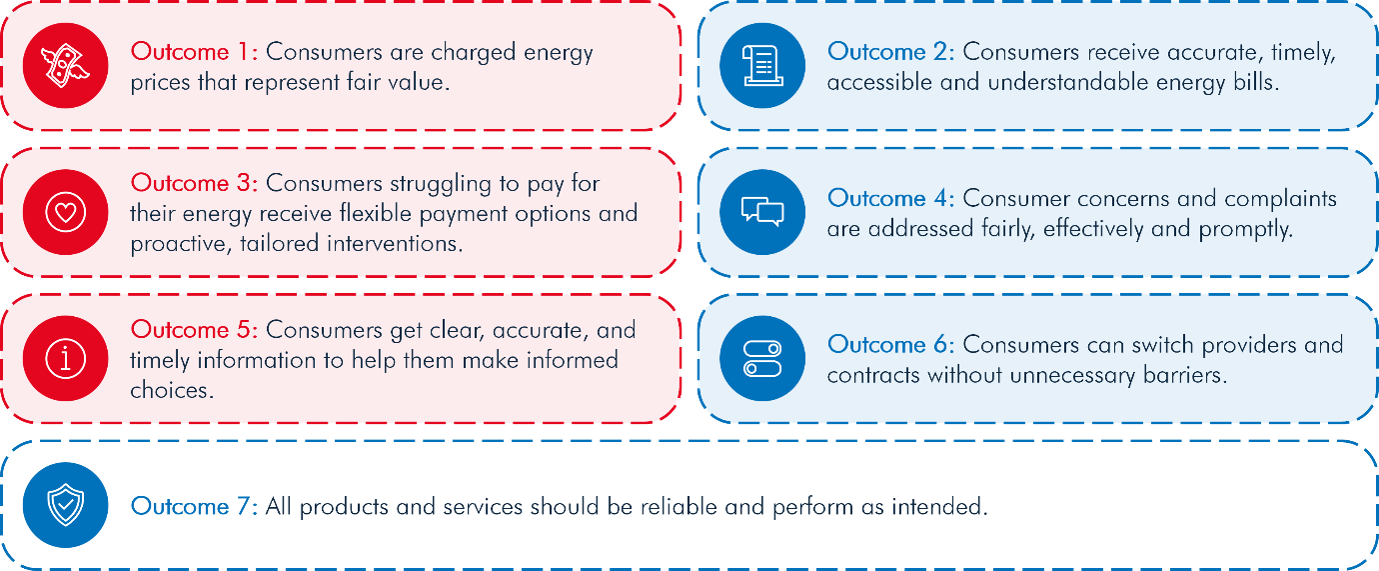
Outcomes-based regulation is also on the horizon for suppliers. On 23 June, Ofgem published its proposed options for implementing an outcomes-based approach to regulation across both the domestic and non-domestic retail supply markets. The document identifies seven final consumer outcomes.
Consumer outcomes >The outcomes will be implemented in phases, to ensure they work across different areas of the market, with any lessons learned informing the development of outcomes for heat networks and, eventually, TPIs.
In the consultation, Ofgem confirmed it is starting with the billing outcome, as it is proportionate and “achievable”. This aligns with recent Energy Ombudsman data showing that 62% of the 7,168 micro and small business disputes it investigated in the first half of 2026 related to billing.
Three routes are currently under consideration:
- Outcomes-only delivery of billing standards
- An outcomes-led framework with targeted protections for the highest-risk harms (e.g. backbilling)
- A mixed approach combining the billing outcome with prescriptive rules
The consultation also stated that better-quality data and deeper insight will be needed to monitor supplier performance and proactively identify emerging issues.
Market-wide Half-Hourly Settlement Migration
Industry migration to market-wide half-hourly settlement (MHHS) continues to gather pace, with 20.2 million meters migrated as of 28 August 2026 (around 60% of all meters in scope) and supplier volumes in line with the programme’s agreed migration framework ahead of the 7 May 2027 completion date (Milestone 15). CGP’s own migration is progressing well behind the scenes with over 20% of its portfolio successfully migrated, well in line with our internal delivery plan.
Other Headline News:
- Great British Grid launched: On 29 September, the Prime Minister announced Great British Grid, a new publicly owned body within Great British Energy that will invest in network infrastructure and compete for transmission projects, funded initially from Great British Energy’s existing budget.
- New Department for Business, Innovation, Science and Trade (BIST): The Department for Business and Trade has been renamed bringing business support, trade policy and innovation funding under one roof, following the disbandment of the Department for Science, Innovation and Technology. BIST remain responsible for the ongoing design and administration of the British Industrial Competitiveness Scheme.
- ESNZ Committee probes business energy costs: The Energy Security and Net Zero Committee’s Business and Energy inquiry is examining how high energy costs affect business decarbonisation and economic growth. It is focusing on the lack of a wider longer term strategy for industrial electrification, beyond BICs and EII support, and on how to help SMEs, which make up 99% of UK businesses, invest in going green.
- NESO updates its Beyond 2030 plan: In July, NESO refreshed its Beyond 2030 recommendations, estimating that around £89bn of investment in Great Britain’s electricity grid will be needed through the 2030s.
- AI in the energy system: Government has launched a call for evidence on how artificial intelligence can support a cleaner, smarter energy system.
 My Account